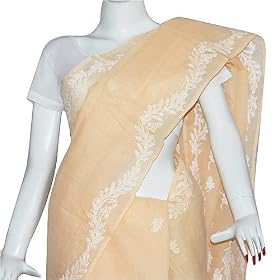
 I really like this Sari. I bought it for my wife. The sari is perfect gift for her. She says that it does its job. Product was exactly like description, I am very happy with my purchase.Thanx Shalincraft
Product Description
Chikan embroidery is a specialty of Lucknow in north India. Unique style of embroidery was developed during the Mughal period (16th to 18th century) in India. The embroidery style developed then, continue to popular today. Village women living around the city of Luknow execute the embroidery work.
An Indian saree is the most commonly seen costume of unstitched cloth worn by women across South Asia. Varying in size, style, pattern, color and richness, it crosses all class and caste barriers, regional traditions and urban fashions continue to contribute to its repertoire of design forms. Each area in India has its own distinctive method of draping a saree. One end is generally worn tucked at the waist into a petticoat, pleated and then wound around the legs to make a long skirt reaching to the ankles; the remaining end may be thrown over a shoulder or over the head. A widow is frequently expected to wear a white saree older women wear dark tone, while bright colures are reserved for younger women. Wedding sarees are often red, as it is an auspicious color; although in Kerala they tend to be white. A saree may vary in length from about three to eight meters and is usually considered in three parts: a field, an end-piece and borders along the length. The field may be plain, printed or embroidered, with plain or patterned borders. The width and decoration of the borders are dictated by regional variations and often help to distinguish between areas of origin. The end-piece (pallu or palan) is usually draped over the shoulder and may be embellished.
Click Here to see more reviews about: Indian Saree Cotton Chikan Embroidery Peach (chsari118)

No comments:
Post a Comment